
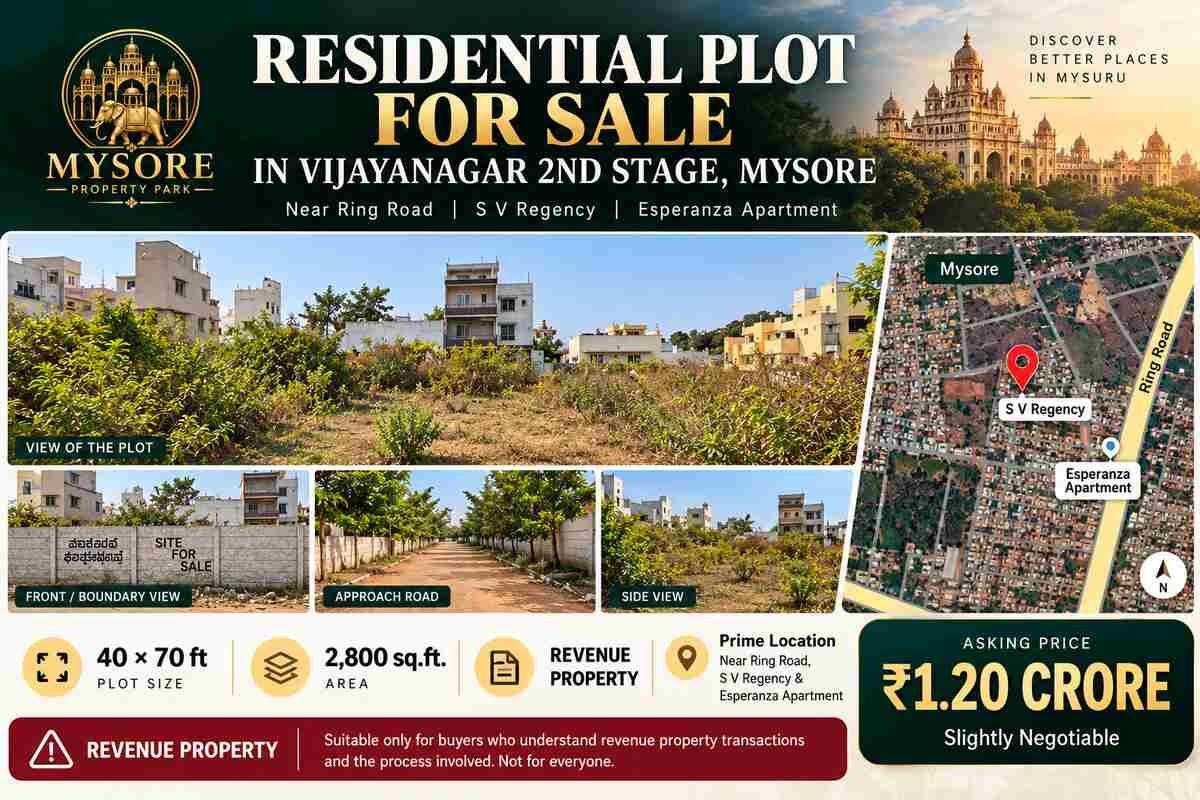
A 2,800 sq.ft. 40 × 70 property is available for sale in Vijayanagar 2nd Stage, Mysuru, close to Ring Road, S V Regency Apartment and Esperanza Apartment.
The asking price is ₹1.20 Crore, slightly negotiable.
But there is an important point that prospective buyers should understand before considering this property:
This is a revenue property.
It is not being presented as a conventional approved residential site. It is a property that requires the buyer to understand its documentation, land status, applicable permissions and construction implications before making a decision.
That is exactly why this article is not just a property listing.
At Mysore Property Park, we believe buyers should understand what they are buying before they decide whether they want to buy it.
AT A GLANCE
Property Details
- Location: Vijayanagar 2nd Stage, Mysuru
- Plot Size: 40 × 70 ft
- Total Area: 2,800 sq.ft.
- Property Type: Revenue Property
- Asking Price: ₹1.20 Crore
- Price: Slightly Negotiable
- Nearby: Ring Road, S V Regency Apartment, Esperanza Apartment
- Ownership: Direct Owner
- Suitable For: Buyers and investors who understand revenue properties and are comfortable with appropriate legal and technical due diligence
Important
This is a revenue property and is not being represented as a conventional approved residential site.
A prospective buyer should independently verify the title, land status, conversion, planning/layout status, construction eligibility, encumbrances and other applicable matters before entering into the transaction.
1. A 40 × 70 Property in Vijayanagar 2nd Stage, Mysuru
The property measures approximately 40 × 70 feet, giving a total area of 2,800 sq.ft.
It is located in Vijayanagar 2nd Stage, Mysuru, in the vicinity of the Ring Road and established residential developments including S V Regency Apartment and Esperanza Apartment.
The size itself is one of the property’s notable characteristics.
A 40 × 70 property provides considerably more land than the commonly encountered 30 × 40 residential site and can therefore attract buyers looking for a larger parcel.
However, location and size are only part of the equation.
The more important consideration in this particular property is its revenue status.
And that is something every prospective buyer should understand before looking at the property purely from a price-per-square-foot perspective.
2. What Exactly Is a Revenue Property?
“Revenue property” is a term commonly used in the property market, particularly when discussing land that is recorded or dealt with through revenue/land records and does not have the same approval profile as a conventional approved residential site.
However, it is important to understand that “revenue property” is a market description, not a complete legal conclusion about a property.
The actual status of a property depends on its specific documents and circumstances.
Depending on the property, a buyer may need to understand:
- Ownership and title
- Previous ownership records
- RTC and other land records where applicable
- Mutation records
- Land classification
- Conversion status
- Survey records
- Layout or subdivision status
- Applicable planning/zoning
- Road access
- Encumbrances
- Construction permissions
- Other applicable approvals or restrictions
This is why two properties described as “revenue properties” can have very different legal and practical circumstances.
The label alone is not enough.
3. Revenue Property Does Not Automatically Mean Illegal
This is probably the biggest misconception surrounding revenue properties.
You may hear people say:
“Revenue site means illegal.”
That is too simplistic.
The term “revenue property” by itself does not establish that a property is legal or illegal.
The correct question is:
What is the actual legal and planning status of this particular property?
For example, if land was originally classified for agricultural use and is now being considered for residential use, the buyer needs to understand whether the required conversion or other permissions are applicable.
Similarly, if land has been divided into individual sites, the buyer should understand the status of that subdivision/layout and whether the relevant planning requirements have been satisfied.
The important point is:
Do not judge the property solely by its label. Examine the underlying documents.
4. Registration Does Not Mean Everything Is Approved
This is another important distinction.
A buyer may sometimes assume:
“If I can register the property, everything must be legally approved.”
That is not necessarily the case.
Registration of a transaction and approval for a particular land use or construction are different matters.
For example, the documentation relevant to property registration and the documentation relevant to conversion, layout approval or building permission can be different.
Mysuru City Corporation’s published procedures for new khata/property records refer to documents such as the registered deed, Encumbrance Certificate, land conversion documentation, applicable urban development authority approval and layout plan. Its building-license process separately lists documents including title deed, EC, conversion/change-of-land-use documents where applicable, revenue sketch where applicable and a detailed building plan. OASIS
Therefore:
A registered sale deed should not be treated as automatic proof that every development or construction permission is already in place.
5. Can You Build a House on a Revenue Property?
This is one of the first questions most buyers will ask.
The answer is:
Do not assume that you can simply build because you own the property.
Whether construction can proceed, and what approvals are required, depends on the property’s actual status and the requirements of the relevant authority.
This is particularly important for a property being represented as a revenue property.
A common myth:
“It’s a revenue site. You don’t need a building plan.”
The safer reality:
Construction should be undertaken only after establishing the applicable permissions and approvals.
For example, Mysuru City Corporation’s published building-license procedure includes submission and verification of relevant property documents and drawings, site inspection and building-plan approval. The listed documents include a detailed building plan and architect licence copy, along with conversion/change-of-land-use documents where applicable. OASIS
So a buyer should never purchase a revenue property based on an assumption that:
“I can buy it today and start construction tomorrow.”
6. What About Conversion?
This is another area where buyers often get confused.
Land can have a particular classification and permitted use.
If land originally has an agricultural classification and is proposed to be used for residential or another non-agricultural purpose, the applicable conversion or change-of-land-use requirements need to be understood.
But it is important not to apply one blanket rule to every property.
The requirements can depend on:
- Existing land classification
- Location
- Planning jurisdiction
- Existing approvals
- Proposed use
- Applicable development regulations
Therefore, for a revenue property, conversion status should be one of the items checked during due diligence.
Do not assume:
“There are houses around it, so the land must automatically be residential.”
The surrounding development is useful context, but the property’s own documents and applicable planning status are what matter.
7. Can You Get a Home Loan for a Revenue Property?
This is one of the most practical questions for a buyer.
The simple answer:
Do not assume that a standard home loan will be available.
Banks and financial institutions have their own legal and technical due-diligence requirements.
They may examine:
- Title
- Land status
- Conversion
- Layout/planning approvals
- Construction eligibility
- Property documents
- Valuation
- Other factors under the lender’s policy
A revenue property may therefore be treated differently from a conventional approved residential site.
This does not mean that every property described as a revenue property is automatically impossible to finance.
It means that the buyer should check with the intended lender against the actual property documents before depending on loan finance.
An important distinction:
Property registration and bank loan eligibility are two different questions.
8. Why Would Someone Buy a Revenue Property?
If revenue properties require additional due diligence, why do buyers consider them?
There can be several reasons.
Larger Plot Sizes
Revenue properties can sometimes offer larger land parcels or dimensions that are harder to find in conventional residential layouts.
In this case, the property measures 40 × 70 ft or approximately 2,800 sq.ft.
Established Locations
Some revenue properties are physically located in areas where substantial residential development has already taken place.
That can make the location attractive even though the property’s documentation or approval profile may differ from a conventional residential site.
Investment Potential
An experienced buyer may be willing to take on additional due diligence if the location, size and price make the opportunity attractive.
Land Value
For some buyers, the underlying land and location may be more important than immediate construction.
But these potential advantages should always be considered alongside the risks and documentation.
9. What Are the Risks of Buying a Revenue Property?
A revenue property is not necessarily a bad property.
But it can require more careful due diligence than a conventional approved residential site.
Some of the issues a buyer should consider include:
Construction
Can the intended residential construction be legally undertaken, and what permissions are required?
Financing
Will the intended bank or lender finance the property?
Documentation
Are the title, land and revenue records consistent?
Planning
What is the applicable planning/zoning status?
Conversion
Is conversion applicable, and if so, has it been completed?
Layout / Subdivision
If the land has been divided into individual sites, what is the status of that subdivision or layout?
Resale
Some future buyers may only consider fully approved residential sites, which could affect the pool of potential purchasers.
Future Restrictions
Road widening, reservations, planning restrictions or other issues may affect the property and therefore need to be checked.
The key point is simple:
The more complicated the property, the more important proper due diligence becomes.
10. Revenue Property: Myths vs Reality
There are many statements about revenue properties that are repeated as absolute truths.
Here are some of the most common ones.
| Myth | Reality |
|---|---|
| Revenue property is illegal | Not necessarily. The actual legal status depends on the property’s documents and applicable rules. |
| Registration means everything is approved | No. Registration and development/construction permissions are separate matters. |
| You can build without a plan | Do not assume this. Applicable building permissions need to be established. |
| Banks never give loans | Loan eligibility depends on the property and lender’s policy. |
| Houses around the property mean it is residential | Surrounding development does not by itself establish the property’s legal status. |
| Khata means clear title | No. Khata/property records and title are different matters. |
| EC proves the property is completely safe | No. EC is an important document but not a substitute for complete legal due diligence. |
| Revenue properties are always cheaper | Not necessarily. Location, size, demand and documentation all affect value. |
| Every revenue property is risky | Not necessarily. The actual risk depends on the property’s specific documentation and circumstances. |
The best approach is not to believe either extreme.
Understand the property. Verify the documents. Then make a decision.
11. What Should You Check Before Buying a Revenue Property?
This is where buyers should slow down.
Before paying a substantial advance, consider having the following examined by an appropriate professional.
Ownership and Title
- Current sale deed
- Previous title documents
- Chain of ownership
- Seller identity
- Seller’s authority to sell
- Any inheritance/partition/release documents where applicable
Land Records
- RTC / relevant land records
- Mutation records where applicable
- Survey records
- Survey sketch
- Land classification
- Conversion documents where applicable
Property and Planning
- Layout/subdivision status
- Applicable planning approval
- Zoning
- Road access
- Any reservation or acquisition issues
- Construction eligibility
Financial / Encumbrance Checks
- Encumbrance Certificate
- Existing mortgage
- Loan closure/release documents where applicable
- Outstanding dues
Physical Verification
- Actual site dimensions
- Boundaries
- Road access
- Location
- Survey identification
Mysuru City Corporation’s published procedures also illustrate why these checks matter: its property-related processes refer to documents such as sale deeds, ECs, conversion documents, urban development authority approval/layout plans and other applicable records. OASIS
12. Don’t Just Check the Documents. Compare Them With the Property.
This is one of the most important parts of property due diligence.
You should not verify documents in isolation.
Compare the information in the documents with the actual property.
For example:
Sale deed
↓
Survey details
↓
Property records
↓
Layout/site details
↓
Physical boundaries
↓
Actual property on the ground
If these do not line up, stop and investigate.
A document may say:
40 × 70 ft
But what is actually available on the ground?
The survey number may be correct, but is the boundary correct?
The seller may have a registered document, but does the person selling the property have the authority to sell it?
The property may be surrounded by houses, but what does the property’s own documentation say?
These are the questions that matter.
The principle is simple:
Paper should match reality.
13. Who Is This Property Suitable For?
This property is not necessarily for everyone.
That is something we would rather state clearly.
It may be suitable for:
- Experienced property buyers
- Investors familiar with revenue properties
- Buyers looking for a larger 40 × 70 parcel
- Buyers who understand the additional due-diligence requirements
- Buyers who can evaluate the property without assuming immediate bank finance
- Buyers with an appropriate investment horizon
It may not be suitable for:
- First-time buyers looking for a completely straightforward residential site
- Buyers who require immediate construction
- Buyers who depend entirely on a standard home loan
- Buyers uncomfortable with additional documentation and planning checks
- Buyers looking for a conventional approved residential layout
The right buyer for this property is not simply someone who likes the location.
It is someone who understands what they are buying.
14. About This Vijayanagar 2nd Stage Property
The property being presented through Mysore Property Park is a 40 × 70 ft property measuring approximately 2,800 sq.ft., located in Vijayanagar 2nd Stage, Mysuru.
Location
Vijayanagar 2nd Stage, Mysuru
Close to:
- Ring Road
- S V Regency Apartment
- Esperanza Apartment
- Established residential development
Property
40 × 70 ft
2,800 sq.ft.
Revenue Property
Asking Price
₹1.20 Crore
Slightly Negotiable
The property is being offered directly by the owner.
Interested buyers can request the available property details, photographs, location information and documents before proceeding with a site visit.
15. Why Is Mysore Property Park Being So Transparent About This?
At Mysore Property Park, we don’t believe every property needs to be presented as suitable for everyone.
Some properties have straightforward documentation.
Some require more investigation.
Some are suitable for first-time buyers.
Others are better suited to experienced investors.
A revenue property falls into the second category.
We would rather clearly tell a buyer:
“This is a revenue property. Understand what that means before you proceed.”
than allow a buyer to discover that after paying an advance.
Our approach is simple:
Understand first.
Verify second.
Decide third.
16. What Mysore Property Park Can Help You With
Buying property involves much more than finding a photograph and a price.
At Mysore Property Park, our objective is to help buyers discover relevant property opportunities while providing clearer information about what they are considering.
We can help you:
UNDERSTAND
What the property is and what questions need to be asked.
FIND
Property opportunities based on your location, size, budget and requirements.
CONNECT
You with property owners and relevant professionals where required.
EXPLORE
The location, property details and available information before you make a decision.
Important
Mysore Property Park is not a legal service provider.
Title verification, legal opinions, technical verification, loan eligibility and other professional matters should be independently reviewed by qualified professionals.
FREQUENTLY ASKED QUESTIONS
What is a revenue property?
Revenue property is a commonly used market term for land/property whose documentation or land-use/approval profile differs from a conventional approved residential site. The exact legal status must be determined from the property’s own records and applicable approvals.
Is a revenue property illegal?
Not necessarily. The term itself does not establish that a property is legal or illegal. Buyers need to examine title, land records, conversion, planning status, layout/subdivision and other applicable matters.
Can I register a revenue property?
The ability to register a transaction and the property’s eligibility for a particular use or development are separate questions. Registration should not automatically be interpreted as confirmation that every required approval is in place.
Can I build a house on a revenue property?
Do not assume that construction is automatically permitted. The buyer should first establish the property’s applicable land-use, planning and building-permission requirements.
Do I need a building plan?
A buyer should not assume that a revenue-property status removes the need for applicable building permissions. The relevant authority’s requirements should be checked before construction.
Can I get a home loan for a revenue property?
Do not assume that a conventional home loan will be available. Loan eligibility depends on the property documentation and the individual lender’s legal, technical and lending policies.
Does having a khata mean the property has clear title?
No. Khata/property records and title are different matters. A khata-related record should not by itself be treated as conclusive proof of ownership or approval.
Is an Encumbrance Certificate enough?
No. An EC is an important part of property due diligence, but it should be considered along with title documents, land/property records, approvals, physical verification and other relevant checks.
Is a revenue property a good investment?
There is no universal answer. The decision depends on location, price, title, documentation, planning status, construction potential, financing, holding period and the buyer’s risk tolerance. Experienced buyers may evaluate such properties differently from first-time residential buyers.
What should I check before buying a revenue property in Mysuru?
At minimum, understand the title, ownership chain, EC, applicable land records, mutation, survey details, land classification, conversion status, layout/planning status, access, construction eligibility and any restrictions or encumbrances. A qualified property lawyer should review the transaction before a significant financial commitment.
FINAL TAKEAWAY
A revenue property is not something to automatically reject simply because it is called “revenue.”
But it is also not something to purchase simply because:
“Houses are already there.”
or
“Everyone around has built.”
The real questions are:
Who owns the property?
How was the property created and transferred?
What do the land and property records say?
Is the applicable conversion in place?
What is the planning/layout status?
Can the intended construction legally proceed?
Will the intended lender finance it?
Does the property on the ground match the documents?
And most importantly:
Has the property been independently verified before paying a substantial advance?
Property buying should not be based only on:
Price + Location + Photos
It should also be based on:
Ownership + Documents + Land Status + Approvals + Physical Verification + Due Diligence
The right property is important. Knowing exactly what you are buying is even more important.
Looking for a Property in Mysuru?
Whether you’re looking for a residential site, house, apartment, investment property or land opportunity, tell us what you’re looking for.
Mysore Property Park
Discover Better Places in Mysuru.
For enquiries regarding this property:
Call / WhatsApp: 86818 22228
Disclaimer
This article is intended for general informational purposes and should not be considered legal, financial, planning or construction advice. The term “revenue property” is commonly used in the property market and does not by itself establish the legal status of any particular property. The actual title, land classification, conversion status, layout/planning approvals, construction eligibility, encumbrances and other applicable matters must be independently verified for the specific property. Prospective buyers should obtain appropriate legal and technical advice and verify the relevant records with the competent authorities before entering into a transaction or making a significant financial commitment.