
Buying a property can begin with a photograph, a location and a price.
But before you pay an advance, the more important question is:
What exactly are you buying, and what documents support that claim?
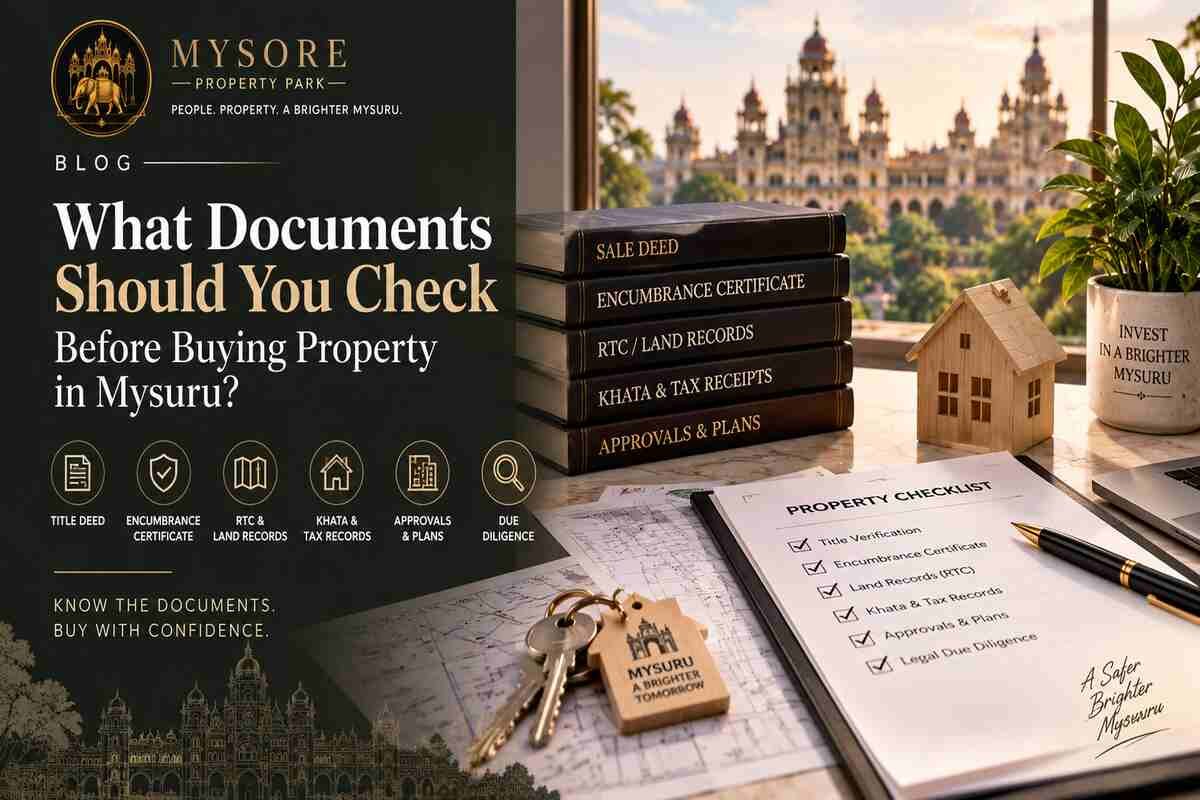
A property transaction can involve title documents, previous ownership records, land or property records, Encumbrance Certificates, tax records, approvals, layout documents, building permissions and other documents depending on the type of property.
There is also an important distinction between having a document and having a document that has been properly examined in the context of the entire transaction.
This guide explains the major property documents buyers in Mysuru and Karnataka may need to understand, what each document is generally used for, and what you should look for before committing significant money.
The exact documents required vary depending on whether you are buying a plot, apartment, house, agricultural land, commercial property or another type of property. Legal due diligence should therefore be carried out by a qualified property lawyer for the specific transaction.
AT A GLANCE
Before buying property, you may need to examine:
- Current title / sale deed
- Previous title documents
- Encumbrance Certificate
- RTC / land records where applicable
- Mutation records where applicable
- Khata / property records where applicable
- Property tax records
- Conversion documents where applicable
- Approved layout / plan
- Building approval documents where applicable
- RERA information for applicable projects
- Survey and boundary records
- Loan / mortgage release documents where applicable
- Identity and authority documents of the seller
- Other property-specific approvals and NOCs
The important point:
No single document tells you the complete story of a property.
The documents need to be looked at together.
1. Start With the Current Title / Sale Deed
The current title document is one of the most important documents to examine.
For a property that has been previously sold, the current registered sale deed generally records the transaction through which the present owner acquired the property.
Look at:
- Name of the seller/current owner
- Property description
- Survey number or property identification details
- Site dimensions
- Extent/area
- Boundaries
- Consideration
- Registration details
- Previous document references
- Whether the description corresponds with the actual property
Don’t stop at the first page
The property description needs to make sense when compared with the other available records.
For example:
Sale deed → Survey details → Property records → Physical property
If the measurements, survey numbers, names or boundaries do not line up, that should be investigated before proceeding.
2. Check the Previous Title Documents
A current sale deed doesn’t necessarily tell you the entire ownership history.
Depending on how the current owner acquired the property, previous documents may include:
- Earlier sale deeds
- Gift deeds
- Partition deeds
- Release deeds
- Settlement deeds
- Inheritance-related documents
- Court orders where applicable
- Other instruments through which ownership changed
This is sometimes referred to as examining the chain of title.
Why does this matter?
Imagine a seller purchased the property from another person five years ago.
You shouldn’t necessarily look only at the seller’s sale deed.
You may also need to understand:
Who owned it before them?
How did they acquire it?
Does the sequence of ownership make sense?
This is one of the areas where a qualified property lawyer’s review becomes particularly important.
3. Encumbrance Certificate — EC
The Encumbrance Certificate (EC) is one of the documents many property buyers in Karnataka encounter during due diligence.
Karnataka’s Kaveri 2.0 system provides services including Encumbrance Certificate, certified copies, property valuation and registration of transactions such as sale, mortgage, lease, gift and partition documents.
What does an EC help you examine?
An EC can provide information about registered transactions/encumbrances recorded against the property for the relevant period.
Depending on the property and search period, it can help identify entries such as:
- Registered sale transactions
- Mortgages
- Other registered instruments
But remember:
An EC is not a complete title certificate.
It should not be treated as proof that every possible issue with a property has been eliminated.
It needs to be considered alongside:
- Title documents
- Previous documents
- Land/property records
- Court/dispute checks where relevant
- Approvals
- Physical verification
Kaveri 2.0 currently supports online EC-related services, including digitally signed e-EC processes through the Karnataka Department of Stamps and Registration.
4. RTC / Record of Rights — Where Applicable
For certain land transactions, particularly agricultural and revenue-land contexts, the RTC (Record of Rights, Tenancy and Crops) can be an important record to examine.
Karnataka’s Bhoomi system is the state’s land-record management system. Government information describes RTCs as part of the digitised land-record system, with ownership and other changes reflected through mutation.
Depending on the property and transaction, the RTC may contain information relating to:
- Land details
- Ownership/rights
- Tenancy-related information
- Cultivation/crop information
- Revenue-related details
Important
Not every urban property purchase will be evaluated in exactly the same way using RTC.
For a typical urban site, apartment or commercial property, other property and municipal records may be more relevant.
The applicable records depend on the property.
5. Mutation Records
Mutation refers broadly to updating the relevant land records following changes such as sale, inheritance or other transfers.
Karnataka’s Bhoomi system records ownership or other changes in RTCs through the mutation process. Government sources also provide services for mutation extracts and mutation status.
What should a buyer understand?
If the property is one for which mutation records are relevant, check whether the relevant changes in ownership/rights have been reflected appropriately.
Again, mutation is not the same thing as title.
A mutation entry should not by itself be treated as conclusive proof of ownership.
6. Khata / Property Records
For applicable properties within urban/local-body jurisdictions, buyers may encounter khata or other property records.
These records can relate to the property being recognised in the relevant local authority’s property/tax system.
Depending on the jurisdiction and property type, records may include information associated with:
- Property identification
- Owner details
- Property dimensions
- Tax assessment
- Property tax
Important distinction
Khata is not the same thing as title.
A property having a khata-related record does not automatically mean that all title, approval or legal issues have been resolved.
Treat it as one part of the overall document set.
7. Property Tax Paid Receipts
Check whether applicable property taxes have been paid.
Depending on the property, this could include municipal or local-authority property tax records.
Look for:
- Property identification
- Owner details
- Assessment details
- Payment status
- Outstanding dues
Why check this?
Outstanding property taxes or other dues can create issues that should be understood before completing the transaction.
Don’t simply ask:
“Is the tax paid?”
Ask for the relevant records.
8. Conversion Documents — Where Applicable
Land may originally have a particular classification or permitted use.
If land has been converted for another use, the applicable conversion documentation becomes relevant.
For example, a buyer considering land for residential development may need to understand whether the land’s classification and permitted use are appropriate for the intended purchase.
Don’t assume:
“There are houses nearby, so the land must be residential.”
The actual legal status and applicable approvals should be checked.
This becomes particularly important when buying:
- Land
- Agricultural land
- Converted land
- Layouts
- Development land
9. Approved Layout Plan
If you are buying a plot in a layout, don’t look only at the individual plot.
Understand the layout itself.
Depending on the project and applicable authority, examine relevant:
- Layout approval
- Sanctioned plan
- Site number
- Site dimensions
- Roads
- Open spaces
- Amenities
- Common areas
- Relevant authority approvals
Compare three things
Approved layout
Property documents
Actual property on the ground
If the three don’t match, stop and investigate.
10. Building Plan Approval — For Houses and Buildings
If you are buying a constructed property, documents relating to the building can become important.
Depending on the property, this may include:
- Sanctioned building plan
- Building approval
- Completion-related documentation
- Occupancy-related documentation where applicable
- Relevant NOCs
- Other authority approvals
The exact requirements depend on the building, authority and nature of the property.
Why does this matter?
The building you see physically should be broadly consistent with the approvals and permissions applicable to it.
For example, if a building has been substantially altered or extended, you should understand whether those changes were appropriately approved.
11. RERA Documents — For Applicable Projects
If you’re buying a property in a project covered by the Real Estate (Regulation and Development) framework, check the project’s applicable RERA information.
Depending on the project, this can provide information relating to:
- Project registration
- Promoter
- Project details
- Approvals/disclosures
- Completion information
- Other project-related disclosures
Important
RERA does not mean you should stop doing your own due diligence.
It is another source of information within the overall property-buying process.
12. Seller’s Identity and Authority to Sell
You are not only verifying the property.
You are verifying the person selling it.
Check the identity of the seller and whether the person has the authority to enter into the transaction.
This becomes particularly important where the seller is:
- A company
- A partnership
- A trust
- An estate
- A power-of-attorney holder
- One of several co-owners
- A legal heir
- Someone acting on behalf of another owner
Ask:
Who is selling the property?
In what capacity are they selling it?
Do they have the authority to sell it?
This is another area where legal review is important.
13. Power of Attorney — If Someone Else Is Acting
Sometimes the person dealing with the buyer is not the registered owner.
They may be acting under a Power of Attorney (POA) or another form of authority.
If that is the case, don’t simply accept:
“I have authorization from the owner.”
The relevant authority document should be examined and its validity and scope should be appropriately verified.
This should be handled with professional legal advice where applicable.
14. Loan / Mortgage and Release Documents
A property may have been financed through a bank or financial institution.
If there is or was a mortgage, understand:
- Whether the loan is still outstanding
- Whether the lender has a charge/security interest
- Whether a release has been issued
- What documents are required for release
- How the loan will be settled as part of the transaction
Important
Don’t rely only on the seller saying:
“The loan is already closed.”
Ask for the relevant documentation.
15. Survey and Boundary Records
The document may say:
30 × 40
But what is actually present on the ground?
Before buying a plot or land, compare:
- Sale deed
- Survey details
- Site plan
- Layout plan
- Boundary descriptions
- Actual measurements
- Physical boundary markers
This is especially important for land and plots.
A difference of even a few feet can have significant implications depending on the property.
If necessary, use a qualified surveyor/technical professional to verify the physical property.
16. Compare the Documents With the Property
This is the step many buyers forget.
Don’t verify documents in isolation.
Take the information from the documents and compare it with the physical property.
Check:
| Document / Record | Compare Against |
|---|---|
| Sale deed | Actual property |
| Survey number | Survey/property records |
| Site dimensions | Physical measurement |
| Boundaries | Actual boundaries |
| Layout plan | Actual layout |
| Building plan | Existing building |
| Owner name | Seller identity |
| Tax records | Property |
| EC | Title/transaction history |
| Khata/property records | Property details |
The principle is simple:
Paper should match reality.
17. What Documents Should You Check for Different Property Types?
Not every property requires exactly the same document checklist.
Residential Plot
Pay particular attention to:
- Title documents
- Previous title documents
- EC
- Relevant land records
- Mutation where applicable
- Khata/property records where applicable
- Tax records
- Conversion documentation where applicable
- Approved layout
- Survey/boundary details
- Seller identity
- Relevant approvals
Apartment
Depending on the project:
- Sale/title documents
- Previous title documents where relevant
- EC
- Project/RERA information where applicable
- Approved plans
- Relevant completion/occupancy documentation
- Property tax records
- Association/society-related documents
- Loan/mortgage documents where applicable
- Seller’s ownership documents
Independent House
In addition to land/title documents:
- Building plan approval
- Relevant completion/occupancy documents
- Property tax records
- Building-related approvals
- Physical construction verification
- Utility records where relevant
Agricultural / Other Land
Depending on the transaction:
- RTC
- Mutation records
- Survey records
- Title documents
- EC
- Classification/use-related documents
- Conversion documents where applicable
- Restrictions applicable to the land
- Physical boundaries
- Seller’s ownership/authority
Land transactions can be particularly situation-specific, so professional legal and technical due diligence is important.
18. Documents Are Not Enough: Check for Red Flags
Be cautious when:
- The seller refuses to share basic documents
- Names differ across important records without an explanation
- Survey numbers don’t match
- Measurements are inconsistent
- Boundaries are unclear
- The property description is vague
- There are unexplained gaps in the ownership chain
- A mortgage is mentioned but release documentation is unclear
- Construction appears different from approved plans
- The seller is not the apparent owner
- Someone is selling under a POA without clear documentation
- There are unresolved disputes
- You are being pressured to pay a large advance immediately
One rule worth remembering:
Pressure to pay should never replace due diligence.
19. Is One Document Enough to Prove That a Property Is Safe?
No.
This is perhaps the most important answer in this entire article.
You may have:
- Sale deed
- EC
- Khata
- RTC
- Tax receipt
- Approved plan
and still need to understand how these documents fit together.
Property due diligence is about connecting the information, not collecting documents like certificates in a folder.
For example:
Who owns it?
↓
How did they acquire it?
↓
Do the records support that ownership?
↓
Are there registered encumbrances?
↓
Is the property physically what the documents describe?
↓
Are the applicable approvals in place?
↓
Is there anything else specific to this property that needs professional investigation?
That is the real purpose of document verification.
20. Before You Pay an Advance: Document Checklist
Use this as your quick buyer checklist.
Ownership
☐ Current title/sale deed examined
☐ Previous title documents examined
☐ Ownership chain understood
☐ Seller identity verified
☐ Seller’s authority to sell confirmed
Property Records
☐ EC checked
☐ RTC checked where applicable
☐ Mutation checked where applicable
☐ Khata/property records checked where applicable
☐ Property tax records checked
Land / Layout
☐ Survey details checked
☐ Boundaries checked
☐ Physical dimensions checked
☐ Conversion documents checked where applicable
☐ Layout approval checked where applicable
Building
☐ Building plan checked where applicable
☐ Relevant completion/occupancy documents checked
☐ Construction compared with approved plans
Financial / Transaction
☐ Existing mortgage checked
☐ Loan closure/release documents checked where applicable
☐ Outstanding dues checked
☐ Payment terms understood
Professional Due Diligence
☐ Legal review completed
☐ Technical/survey verification completed where required
☐ Property physically inspected
☐ Questions/issues resolved before significant payment
21. Where Can Buyers Find Some of These Records?
Karnataka has several digital systems relevant to property information.
Bhoomi
Bhoomi is Karnataka’s land-record management system. Government sources describe it as the system through which digitised RTCs and mutation-related land records are managed.
Kaveri 2.0
Kaveri 2.0 provides services related to property registration, Encumbrance Certificates, certified copies and property valuation, among other registration-related services.
However, accessing a government record is only one part of due diligence.
Reading the record correctly and understanding how it relates to the rest of the transaction is equally important.
22. What Mysore Property Park Can Help You With
Property documentation can feel overwhelming, especially when you are buying property for the first time.
At Mysore Property Park, we can help you understand the broader property journey, identify what needs to be considered and connect you with appropriate professionals where specialised legal, technical or documentation expertise is required.
Our role is to help you:
UNDERSTAND
What you are buying and what needs to be checked.
FIND
Relevant property opportunities based on your requirement.
CONNECT
You with the appropriate property owner and relevant professionals.
GUIDE
You through the different stages of the transaction.
Important
Mysore Property Park is not a legal service provider.
Legal title verification, legal opinions and other professional advice should be obtained from a qualified professional.
THE 10-SECOND PROPERTY DOCUMENT RULE
Before buying, ask yourself:
Who owns it?
How did they acquire it?
What records support that ownership?
Is there anything registered against it?
Does the property on paper match the property on the ground?
Are the applicable approvals in place?
Has an appropriate professional reviewed the transaction?
If you cannot answer these questions confidently, you may not be ready to pay a significant advance.
FREQUENTLY ASKED QUESTIONS
What documents should I check before buying property in Mysuru?
Depending on the property, you may need to examine the current title/sale deed, previous title documents, Encumbrance Certificate, relevant land or property records, mutation records where applicable, khata/property records, tax records, conversion documents, approved layout or building plans, RERA information for applicable projects, survey details and other property-specific approvals.
Is an Encumbrance Certificate enough to verify a property?
No. An Encumbrance Certificate is an important part of property due diligence, but it should not be treated as a complete title verification. It should be examined alongside title documents, relevant land/property records, approvals, physical verification and other checks appropriate to the transaction.
What is the difference between a sale deed and RTC?
A sale deed is a registered instrument documenting a sale transaction between parties. RTC is a land/revenue record used for applicable land parcels in Karnataka. They serve different purposes and should not be treated as interchangeable documents.
What is Bhoomi in Karnataka?
Bhoomi is Karnataka’s land-record management system. It provides access to land-record information such as RTC and supports mutation-related processes.
What is Kaveri 2.0 used for?
Kaveri 2.0 is Karnataka’s digital platform for several services under the Department of Stamps and Registration, including property document registration, Encumbrance Certificates, certified copies and property valuation.
Should I verify the property documents before paying an advance?
Yes. Before making a significant financial commitment, understand the ownership, relevant documents, encumbrances, approvals, physical property and transaction terms. Appropriate legal due diligence should be completed for the specific transaction.
Does having a khata mean the property has clear title?
No. Khata/property records and title are different matters. A khata-related record should not by itself be treated as conclusive proof of ownership or as confirmation that every legal or approval issue has been resolved.
Should I hire a lawyer before buying property?
For a significant property purchase, obtaining advice from a qualified property lawyer is advisable, particularly where title history, land records, agreements, ownership issues, encumbrances or other legal matters need to be examined.
FINAL TAKEAWAY
A property purchase should never be based only on:
Price + Location + Photos
There is another layer underneath:
Ownership + Documents + Records + Approvals + Physical Verification + Due Diligence
The documents don’t exist merely to complete paperwork.
They help you understand what you are actually buying.
Before you pay a significant advance, take the time to understand the property on paper, compare it with the property on the ground, and obtain the professional advice appropriate to the transaction.
The right property is important. Knowing what you’re buying is even more important.
Looking for a property in Mysuru?
Tell us what you’re looking for and we’ll help you explore relevant property opportunities.
TELL US WHAT YOU’RE LOOKING FOR
Link:/contact-us/
Related article: Buying Property in Mysuru: A Complete Step-by-Step Guide From Search to Registration